 Eggs were a staple of our household for breakfast – for a time. So it was fitting that we did a demonstration of what eggs where to teach him the sign with more than just a few strewn sentences and repetition. We cook on cast iron, so this was a useful element, but you can do it with Teflon too. First I gave my son the egg in its shell and told him verbally to be gentle. I also did the sign so he got the message two different ways. He knew not to drop it because gentle had been reinforced through TOUCH GENTLE as soon as he could wave his arms!
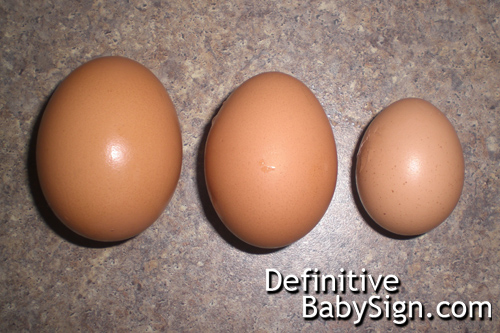 After he had a good sense of the egg as a whole thing, I took it back from him and did the sign for EGG. I gave it back to him and signed it again. Instantly, he waved his arms up and down. The sign for EGG is done as if cracking an egg. The arms are moved thumb up, yet together, to thumb down in a twisting motion. Think of the motion you do while cracking an egg into a pan. Next I heated up the cast iron pan on the stove to the point where it was really hot. I brought it to the floor so we both could watch the demonstration. I obviously put a hot pad on the floor so it didn’t catch fire to anything! I had my wife make sure our son didn’t touch the hot pan and also did the sign for my son’s benefit. The pan is HOT – NO TOUCH. At this point, he understood the sign for HOT. Next I cracked the egg and dropped it into the pan to the amusement of my son. He was delighted to see it instantly sizzle and begin to cook. We then did the sign for EGG again and my son copied his approximation once again.
Naturally what followed was for breakfast! We ate the egg and did the sign for it again.
In the span of 10 minutes we had involved his visual, kinesthetic and auditory senses in addition to his sense of taste. This produced a full lesson for him about eggs.
When you teach signs, think of all the different ways you can get a kids mind working. The more ways you can show something, the more complete the package. From that day forward, my son had an excellent concept of what and egg is, how it’s prepared and how it appears in various forms.
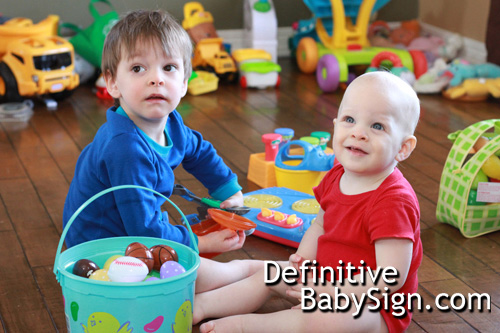 Turns out that signing colours is a difficult thing to do. While my son understood readily the labels and could do the signs, he seemed to guess randomly when quizzed on objects that were unfamiliar to him. With time, he got better, but this might be due to knowing more colours. It seemed that when he concentrated, he would get the colours better. This sort of trial and error progressed from 16 months right through to 20 months plus.