Teaching Crocodile ~ Chris

I tried to teach my son the sign for crocodile at one point and we had a heck of a time.  My son let’s me manipulate his hands, not every baby does though so this helped.  I’m a touchy feely Dad and touch plays an important role in our silent communication.  I find it helps me lead him by example instead of being overly verbose.
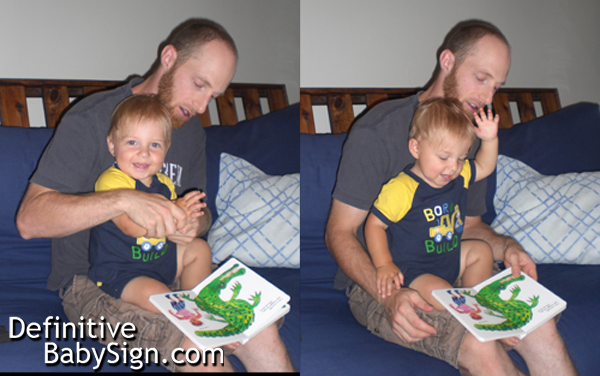
So as I taught him the sign, I found that he wasn’t easily able to turn his hands over palm up and palm down like the sign required with hands spread open coming together like the teeth of a crocodile.  Instead, he would just clap them together.  I assume this is because wrist movements are difficult for a baby to do.  As we worked toward the sign with a cartoon image of a crocodile in a book as an example, I’d grab his hands and try to turn them and model the sign for him as he sit on my lap.  It was to the point that the sign would look like him pulling his hand up over his head exaggeratedly (him trying to turn his wrists over) and finally coming together in a clap.  Amusing to watch but not exactly perfect.  This was his version of the sign and he would repeat it whenever the images was shown and eventually with other real life images in other books and on the Internet.  Because the sign was used in more than one place, we knew it was in fact a sign.  In other words, that’s the real determining factor for a sign approximation.  It works across situations and it somewhat resembles the actual sign.
Posted in Baby Sign Language Techniques, Troubleshooting Baby Sign | Leave a comment

Don’t Be Surprised! ~ Chris

Don’t be surprised when your signing baby starts “talking” to themselves!  After my son learned a few words, he’d sit quietly “reading” a book and quietly signing things he saw.  In fact, from watching him from the side, I knew exactly what he was seeing on the page despite him not saying a word.

I’ve often wondered what non-signers see of us when I can communicate with him certainly without him saying a peep.  Because I habitually mirror what he signs back to him verbally – a good practice for hearing babies – remember we’re moving them toward speaking right – I think maybe other people might just think I’m really good at reading his gestures or that we have a good connection, or maybe just that I’m a bit nuts!  Hard to say really, maybe it’s a little bit of everything, ha!

Bit this brings me to another important point, when signing with your baby don’t be surprised by the amount of skeptics you come across.  Many people will doubt that your baby, who can’t yet speak, is actually saying the things you protest that they are.  I’ve shown signs to many people and since they often happen so quickly and appear at times like normal mannerisms (to the untrained eye), they go unrewarded as having actual meaning.  And then after I’ve shown the signs to onlookers, they usually stand around in bewilderment, shock and what have you, not really knowing what to say at the risk of, I presume, sounding rude.

This is all to say that signing babies aren’t quite mainstream just yet, despite making significant headway in recent years.  So while you deal with non-signers, just be sure to cut them a little bit of slack and take the time to teach them a few signs so they too can enjoy watching your preverbal baby communicate.

Posted in Fun Stuff!, General Baby Sign Language, Thoughs and Theories On Baby Sign | Leave a comment

Translating! ~ Chris

If you sign, and chances are good that you are or will, since you are reading this blog, you’re going to have to be prepared.  Once your baby starts signing, you will endlessly need to translate his signs to all the non-signers around him.  The good news is that each time you do, you’ll have converted another poor soul from the speaking world to the baby sign language world!  Consider yourself an enlightener.  I guarantee that non-signers won’t go long without knowing what little junior is signing about.  You’ll get “Oh, he’s doing this, what does it mean?” or “Hey Mom/Dad, your baby obviously wants something, what is it?”  They might show give him some food and he might sign something back and your relative me be left wondering “Does he want more, less or is he just done – I can’t tell.”  What they will know for sure is that your little guy will be saying something.

The odd time, you get someone rude saying that he’s just doing something weird, but this is quickly dispelled when you explain that signing is so much more peaceful and direct than whining, grunting and reaching.

Bringing your little buddy to family affairs moves him front and center.  When he signs, people listen, they don’t just stare at him saying “Oh, he’s so cute” and dismiss him as being “a stupid baby” – for how could they.  He’s talking, making himself noticed and more importantly is contributing member part of the conversation.  He adds to the topics to be discussed, makes his wishes and desires known, and can accurately express the things he notices around him by labeling them.

Now signing isn’t a rush to turn him into an adult, rather, it’s a way of empowering him and bringing him closer to the things he wants.  Yes, it helps mature him a touch, but not in a way that “ruins his childhood.”  It’s not as if signing moves him closer to moving out, or anything of the sort.  Signing is just a way to ease him out of the “terrible twos”, making his youth more bearable to the rest of us and less frustrating for him everyone, him included.

If you have parents or extended family around you who dismiss signing, then just show them the benefits.  Show them that you can call down whining by using signs show them how signs are an instant mute button and how meeting your baby’s reasonable requests calms him and builds his self esteem.  Most of all, just enjoy sharing your baby with other people and act as the bridge between his signing world and theirs.  Lastly, always be sure to teach non-signers signs that are applicable so they can join in the conversation with your little guy.  Nothing will make them happier than to chat it up with your preverbal guy.

Posted in Baby Sign Tips, Fun Stuff!, Thoughs and Theories On Baby Sign | Leave a comment

Receptive Language And Expressive Language ~ Chris

There will be a time when your baby will be just there, but not signing yet.  This will be when their “receptive” language, meaning their understanding of the words you say and their use are coupled, but their “expressive” language, their ability to communicate based on their understanding hasn’t yet caught up.  Expressive language is a developmental milestone and will happen even if you don’t sign, but signing helps it along because it decouples it from the mechanics of speaking.  This is all getting complicated, but the point I want to make is that there will be a time when your baby understands what you are saying or signing, but isn’t yet able to motivate their bodies to replicate the sign – to communicate.

How do you know when this happens?  Well, you just look for signs of understanding, such as their eyes lighting up, bouncing with joy, or looking toward an object.  For example, say you are signing MILK and what to see if you are even getting anywhere.  Just do the sign and say it and watch for your baby’s eyes to travel to the milk.  Try putting it on the floor with some other things.  When you sign, do they look to the bottle?  Before your baby signs, and for babies that are never taught to sign, this is your current reward, this is proves that your baby gets it.  A baby can have a receptive language in the hundreds of words, but by comparison, their receptive language might only top 50.  This is ever increasing though and eventually receptive and expressive language are nearly equal.  I say this because I’m bilingual, but not exactly one hundred percent proficient.  My reading and comprehension of French is much more advanced than is my ability to speak it.  I have lost of lot of my expressive language even though when I listen to someone speaking French, I understand almost every word.

When we taught my son the sign for WALK – a motivating sign, done by moving the hands up and down as if they are fit hitting the ground, he would instantly get excited and run toward the baby gate.  We knew that he understood what we meant – we just had to wait for him to catch up and do the sign himself.

Posted in Baby Sign Language Techniques, Baby Signing Q&A | Leave a comment

Your Baby’s Physical Limitations ~ Chris

When signing with your baby it’s important to acknowledge your baby’s development and thus their physical limitations.  Baby’s are born without much muscular coordination.  With time and practice they earn the ability to move their bodies as they desire.

In the beginning certain signs/movements are difficult for a baby to do.  For example twisting the hand for APPLE might appear as just the fist or hand to the mouth.  When doing the sign for DAD, the thumb might not protrude and the sign for CAT might not have the outward motion of the finger tips drawn out but rather might have both hands placed on the cheeks.  Baby’s find movement, especially complicated ones, difficult to do.  The sign for BEAR which involves crossing the arms over the chest with fingers clawing (opening and closing) might just appear as one hand clawing absent of arm crossing.  Babies find crossing their arms difficult to do at first.

Consider too that when you model signs that your baby is seeing the mirror image of your example.  That means that your baby might do the opposite motion and movement as they attempt to replicate what they have seen.  The precise location of the sign also often suffers.  Hands might touch the side of the head instead of the forehead, a finger might touch the edge of the nose instead of the mouth and so forth.

None of these “mistakes” should be of any concern.  These are just your baby’s way of working through their signing vocabulary and “sounding” out their words.  With time, the signs will become more refined so long as you continue to show them the right way to do them.

Posted in Baby Signing Q&A, Troubleshooting Baby Sign | Leave a comment