Advanced Baby Signing Through Signed Sentences ~ Chris

As your baby’s signing foundation improves, you can begin to create signed sentences.  This is a great way to keep you and your baby interested in signing.

When baby first starts to sign, you and baby would sign just one key word while the rest of the words are spoken out loud and put into a sentence to provide your baby with context.  The “key word” is the word in the sentence which carries all the meaning.  At different times, depending on what you are seeing or talking about, it might include the noun, verb or adjective.  For example, you might say “Look at the SQUIRREL, it ran down the tree” In this sentence, you signed SQUIRREL, while the rest of the words you just said aloud.  This provides your baby with context and teaches him how language works.  A young baby is not particularly interested in what the squirrel is doing (running) or anything else in the environment such as the tree.

However, once your baby has independently learned to sign TREE and DOWN, as well as SQUIRREL, you can add these to your signed sentence too.  I will caution that to be most effective your baby will understand each word independently so as to avoid unnecessary confusion.  In most cases, it will take quite a while before your baby will have enough words to create sentences…just because it takes so long for a baby to remember them on their own.

So an advanced signed sentence will have two or even three signed words.  “Look at the SQUIRREL, it ran DOWN the TREE.”  In this case, you signed SQUIRREL, DOWN and TREE.

Signing more words in a sentence is a great way to teach your baby more signs to expand their vocabulary and also keep baby signing fresh.
Posted in Baby Sign Language Techniques | Leave a comment

What Is A Sign Approximation? ~ Chris

Sign approximations are something you come across often in the baby sign language world.  It stems from the fact that tiny baby fingers have very little fine motor coordination.  ASL wasn’t designed for their dexterity and lack of precision.  For this reason, baby who sign often do their very best, but it only appears as some close version of the true sign.

In fact, most signs your baby does will appear as sign approximations.  A baby usually leaves out the various handshapes, the complex movements and sometimes even the proper location where the signs should be preformed.  Some babies might even do several signs that look almost identical.  These signs can only be distinguished from other similar signs through context.  While you might think baby is just trying to pull a fast one on you, he’s actually trying to do the sign and likely thinks he’s doing it properly.  What is important, is that you reward these early attempts.  Just like talking never comes out perfect, neither do signs and you wouldn’t hold back on your congrats just because it wasn’t perfect out of the gate.

I will make this point loud and clear, your baby is always trying to do their best.  When they come up short, it’s not because they are somehow slacking off, or giving up, or doing it on purpose to drive you bananas.  A baby is always trying to please those he looks up to in the best way possible.

Posted in Baby Signing Q&A | Leave a comment

When To Start Signing With Your Baby? ~ Chris

The window to teach sign begins after about 10 months of age.  You can start at 9 months and even earlier, but you might wear yourself out before you get the feedback you need from your baby to get excited about it.  After 10 months the full benefits of signing become greater until they peak at about 18 months or so.  From there, spoken language will begin to take over little by little.

If you teach signs, you can expect that your signing baby will have a spoken vocabulary that grows at a great magnitude making signing difficult to maintain.  Once your baby starts to talk, they will be tempted to drop some of the signs they used to sign proficiently.  This shouldn’t be a concern, but rather be a time for celebration.  Keep in mind as you sign, that the goal is to move babies toward talking and to make your life my simpler and more manageable.

As you sign remember that every child develops at their own rate.  And while you can introduce signs from birth, it will probably take at least six months until your baby signs back.  As your baby ages, you should include more complex and abstract signs.  By age 2, your baby will begin to speak and at around the same time, will start combining signs into signed sentences.

To know when a baby is ready to sign, just watch for visual cues.  When you say “milk” does your baby look toward it?  If you clap your hands, will your baby copy?  Does your baby wave their hand for bye-bye?  I talk more about cues that your baby is ready to sign in the online baby signing course.

Whatever you do, just allow signing to evolve at it’s own pace.  It should not involve specific goals or timelines.  Your baby is going to choose their own pace and there’s not a whole lot you can do about it.  When you start, just be consistent and when you introduce a sign, keep signing it as much as possible.

Posted in Baby Signing Q&A | Leave a comment

Seizing The Moment – Relaxed And Focused ~ Chris

Not every moment is created equal as far as teaching baby to sign.  If you’ve started a signing program, than you know exactly what I’m talking about.  I know with my son, there were times when he was totally engrossed in an activity or task and no matter how much I tried, I couldn’t pull him away to teach him to sign anything.

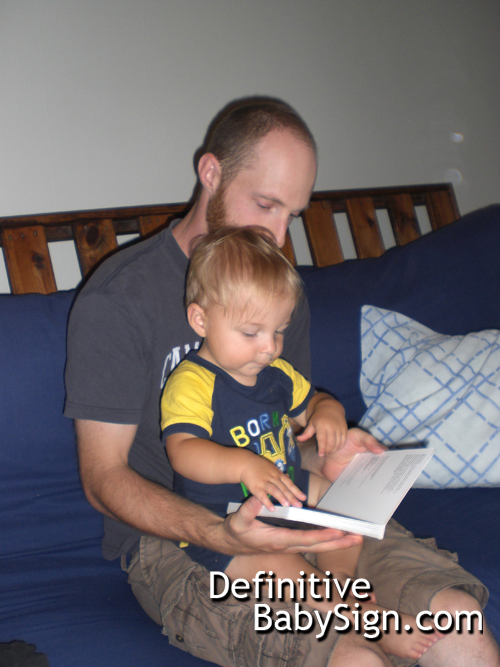
Other times, he was calm, focused, alert.  This is what’s called “shared attention.”  It’s when my son and I were both focused on the same thing.  It could have been anything, such as a bird, butterfly, activity, image or even a person.  These moments can be extremely rare in some babies, while others always seem focused.  Every baby is different.  My son was a pretty good mix of both so he’d play on his own and other times he’d want to play together.  Sometimes he’d like to play with his blocks and other times read books.  To teach signs, you have to cater to your baby’s natural tendencies.  When baby doesn’t want to read books, don’t bother trying to teach signs by looking at images, but when baby is interested, use the moment.  This will make teaching that much more enjoyable.  It means your baby will pick up signs that much faster.

So instead of forcing signs, just let it happen when it’s appropriate. You’d be surprised by how fast your baby will pick signs up when he’s ready.

Posted in Baby Sign Language Techniques | Leave a comment

Was Baby Sign Language Developed For Deaf Children? ~ Chris

It actually wasn’t.  Baby signing was specifically developed for hearing parents and their hearing children.  You can read more about the history of baby sign in another post.  Essentially, it was noticed that babies started to sign back to their deaf mothers much sooner than did hearing babies speak to their hearing mothers.  The logical conclusion was drawn that hearing babies could benefit from signing as their vocal codes and motor coordination caught up to their ability to talk.

Throughout the early experiments and research it was shown that baby that used sign actually reaped significant benefits had they been taught to sign over their non-signing counterparts.  Signing increased IQ, lead babies to talk faster and with greater vocabularies and produced better readers.  This was welcome news to parents and provided them with all the incentive to start signing with their babies.  Since the 70’s there has been significant growth in the popularity of baby sign language.  In fact, most people will know of someone who has taught baby sign language.

And why not?  Baby’s who can sign are more easy to manage, cry less and throw fewer tantrums and can tell other adults what, exactly they want.  This makes them more confident and more secure in what otherwise seems like a chaotic world.  When a baby can sign, they are given a method to produce results they want.  A signing baby for example can ask specifically for a drink – be in MILK or WATER.  There’s no guesswork and so this makes Mom and Dad’s life much easier.

Posted in Baby Signing Q&A | Leave a comment