How Does Baby Signing Boost Self-Confidence And Self Esteem? ~ Chris

Signing allows your baby to join the adult world.  It allows them to make specific requests, to label their thoughts, emotions and interests.  It forces others to listen to them in a way that is specific and difficult to ignore.  Signs empower your baby very early and this has very specific consequences.

It produces a well adjusted child.  Communication allows y our baby to originate conversations.  If they see a bird or truck or anything else, they can identify these things instantly.  Other babies are left pointing, which can often be very frustrating because their signals can be misconstrued making baby feel powerless and disabled.  A signing baby is clear and concise, they sign words specifically.  This makes babies feel validated.  The sooner baby can make signs, the sooner you and they can have constructive conversations together.  Waiting for your baby to speak is totally unnecessary when most babies can sign back at 10-11 months of age.

Posted in Baby Signing Q&A | Leave a comment

Why Baby Sign Language Is Not A Fad ~ Chris

With all the recent interest in baby sign language some people might be tempted to think that baby sign language is a fad and will wane with time.  Naturally, the number of people who do signs with their hearing children might diminish, baby signs will never completely go away.  Baby sign is unlike any other technique advanced to make smarter babies such as signing to baby’s in the womb, or having toddlers listen to Beethoven.  Baby sign language actually has a solid foundation and ready benefits.

Most parents who sign are completely dumbfounded by how much signing babies really notice about their environment.  With signs, a parent can actually see how attentive a baby is and just what they are thinking about.  Babies might not appear all that smart, but a baby who signs can easily dispel this myth.

A signing baby can tell parents what they want to eat and drink.  They can tell their parents when their diaper needs changing.  More so than this, a baby who can sign is one who suffers from reduced frustration.  Baby signing will stick around because parents can actually see, measure and enjoy the results from having taught their babies to sign.

Posted in Thoughs and Theories On Baby Sign | Leave a comment

Signing With Hearing Babies ~ Courtney

When signing with your baby in public, you may have someone ask you if he can hear.  Although many people are now aware of baby sign language for hearing babies, there is still some confusion over why you would do it if your baby can hear.  If you’re reading this, you’re likely not one of those folks who are confused, but rather someone who understands all of the many benefits of signing with your hearing baby!

When we were first teaching our son to sign, we discovered an added benefit that we had never read or heard about.  Once our little guy had some signs in his repertoire to describe his environment, he used them.  Often they were for things he could hear and not see, like a dog or airplane outside.  The fact that he could sign to us what he heard (often before we noticed the sound) told us that his hearing was really good!  At a routine doctor’s appointment we were asked if we had any concerns about our son’s hearing.  We could quite confidently say that his hearing was fine because he was able to tell us clearly what he could hear!  Although a non-signing baby will look up or turn his head when you call his name, he won’t be able to tell you as early what he is able to hear.

Posted in Benefits to Baby Signing, General Baby Sign Language | Leave a comment

The Sign That I Didn’t Know ~ Chris

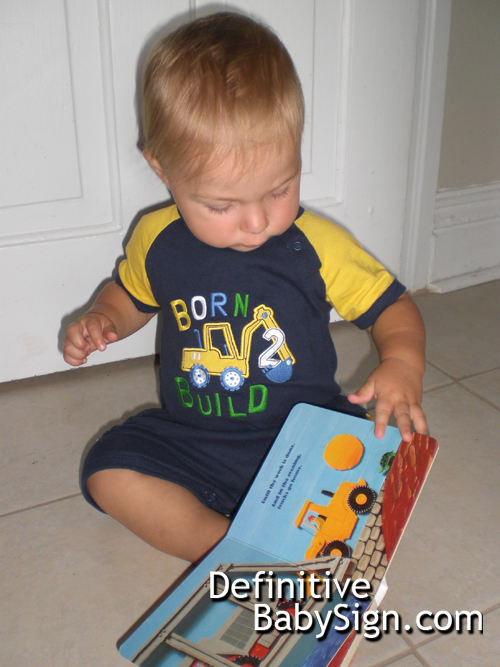
We acquired a new book for our son second hand.  It was a cartoon filled book about as tall as he was and double his width.  Needless to say, there was a lot of things going on, on each page.  Since it was new, he and I had spent some time, but not a lot going over the various names for things verbally as he pointed them out.

My wife was in the other room and our son pointed one by one, fire truck, ambulance, I called them out.  Then he pointed to an image and began signing.  His index and middle finger touched the inside of his palm repeatedly.  I was confused, so I did my best and said “fall down?”  At this our baby signed again, then I asked him for help and told him to point to what he meant.  He pointed at an abstract image again and did the sign which appeared the same as before.  I said to him that I had no idea what he was signing and he got frustrated like I’ve never seen him get before.  I thought to myself that this is what other parents that don’t have signing babies must feel all the time!  He then pointed again, this time it was more clear, he was pointing at a character doing a painting.  So I said “Painting?” and he signed in relief and moved onto the next image.  That was the sign for painting I guess!  My wife chirped in from the other room “Oh, I taught him that the other day!”  Mystery solved!

I couldn’t help but wonder what a child without sign does in such situations.  I supposed it might unfold somewhat similarly. As you blurted out labels for the things they pointed at they’d be comforted but only so long as they matched their mental recollection of the images.  This is no different than a signing baby.  What a non-signing toddler lacks though, is the ability to call out labels on their own – they rely on their parents and caregivers to do it for them.  Both signing and non-signing babies can point and grunt at things, you can guess, and then they can try to correct you.  But when signs are involved, they’re mixed in with the grunting and general annoyance a baby feels from being misunderstood.  However, when both parent and child know the signs, they come to a faster mutual understanding.  This gives a baby both power – to influence other people’s thoughts – and the confidence that this skill brings.  This is likely why babies who sign have so much higher self esteem, they are used to being an active member of their families.  They can talk to other people about the things that are on their minds, they don’t have to wait for other people to bring these subjects up for them.  They can also do these things from the earliest moment possible so long as they are taught to sign at around 9-11 months, and don’t “suffer” from the frustration of being “muted.”

Signs give baby an early voice.
Posted in Fun Stuff!, General Baby Sign Language | Leave a comment

Is Signing A Rush Toward Growing Up? ~ Chris

No.  Signing is a rush toward connecting.  If you are the type of parent who thinks they can connect on a deeper level without words, than signing is not for you.  I like to know what’s on my baby’s mind, so signing was perfect for me.  Not only could I connect with my son, but I could connect on specific ideas.  When he signed, I knew exactly what he was talking about.  I didn’t have to guess or make things up, or play twenty questions, I knew.

Communication isn’t going to grow your baby any faster.  It might advance them in terms of vocabulary, add some IQ points and so forth, but it’s not going to turn them into little adults any sooner.  You’ll get some nice side benefits though, they’ll be able to use manners, label their emotions, ask for things specifically, talk about what’s on their mind and so forth.

To me, signing was always about connection with my son and not about trying to turn him into an adult.  I just say signing as the best way to make his life more comfortable and by extension, mine too.  We also had plenty of great moments along the way that I doubt non-signing parents experience.

Keep reading the blog to find out more about how my son and I experienced his first years of life J

Posted in Baby Signing Q&A, General Baby Sign Language | Leave a comment