Still Signing When He Doesn’t Feel Comfortable ~ Courtney

Our son is now a very verbal two-year-old. In fact, he doesn’t even remember many signs due to lack of use. We still show him now and again and he’ll mimic in much better precision than he did when he was actually using them for communication, but you can tell he doesn’t recollect much of his former language.

We were out yesterday and a stranger thanked him for something. I prompted him to say, “You’re welcome,” and he signed to her instead of speaking. I remarked to my husband later in the day that although he has dropped most of his signs, he usually still signs his manners (i.e., Thank you, Please, Sorry). My husband believes it must have something to do with our son’s comfort with strangers. He went through a very shy, hide-his-face-behind-my-legs phase, but he’s mostly grown out of that. Chris’ comment made me realize though, that our son also still signs greetings, as in HELLO and GOODBYE.

Posted in Benefits to Baby Signing | Leave a comment

Why And How Does Signing Reduce Crying? ~ Chris

Some parents who are considering signing to their babies might wonder how signing can possibly reduce crying and temper tantrums.

This is simple. Signing babies have the language necessary to communicate their wants and needs. It’s been postulated that tantrums are the result of an increase in muscular coordination, coupled with an increase in desires absent of the language with which to communicate this to others. This makes sense, a child who is unable to talk will resort to primitive means of getting their point across. You’ve witnessed this with adults too. An out of control sports coach suddenly and impulsively beings to wail their fists in the air, shout out loud bursts of profanity, throw sticks and even strike the referee or players. This is a person on high emotion unable to control themselves. A toddler is no different, but with time we learn that these types of behaviours, while being a satisfying outlet for our rage, doesn’t agree with other people. Eventually, most of us learn to use language to convey clear thoughts and learn to manage ourselves in more mature ways.

A signing baby is one who has a larger vocabulary and can vocalize their desires more readily. Because signing parents communicate with them directly, they feel heard, even if not always obeyed. Let’s face it, we can’t always let a toddler have what they want, and this is where communication helps. As parents we need to set limits and boundaries and this is why I always say that parents should take the time to say “no” at least some of the time so that your baby is used to hearing it. Remember, just because your baby signs something, does not mean that you need to do it. Parents still need to be the boss and make responsible decisions for their child.

Posted in Baby Sign Language Techniques, Benefits to Baby Signing | Leave a comment

Every Baby Is Different ~ Chris

Just like a baby will choose which signs they learn to sign based on their interests, a toddler will decide which signs they continue signing as their verbal language develops.

Every baby is different. Some babies will speak very early and very clearly and so signs will quickly take a backseat to spoken words. Other babies will take up talking at a slower rate and will rely more on signs to get them by. By in large, most babies will show a mix. However, it would be a mistake to think that signs prohibit spoken language development and this myth has been dispelled previously. What will happen with babies who talk later is that they will use signs to help get them by on the words they find difficult to say. Babies find making certain sounds easier than others.

My son, for example, had trouble saying certain sounds while others came easily. Trough trial and error, he corrected this. But he figured out which sounds he couldn’t make and would use signs to clarify what he meant. When we told him we didn’t know what he meant, he would do the sign to accompany his best attempt at a sign. Sometimes his signs were also approximated and so he’d have a verbal and sign approximation going at the same time. By coupling both of them, we figured out what he meant. As your child develops verbally, signs will be a great tool they can use to help convey their thoughts with more clarity. Once it’s clearly understood what is meant, the signs will be stripped away. That is unless your family continues to sign into toddler years. In this case, your child will simply fall in line with what’s normal for the house. Toddlers are excellent imitators and are easily let by example.

Posted in General Baby Sign Language | Leave a comment

Plug-And-Play Versus Connection ~ Chris

Can babies learn to sign by watching signing language DVD’s? Plug-and-play versus connection.

Sure they can. Babies can also learn many other things through television. In fact televisions can also make great substitutes for parents! Of course I’m being tongue in cheek here, but my point is that while the television can teach baby’s to sign, and there are no shortage of easy plug and play format for you to choose from, signing is a means more than just an and.
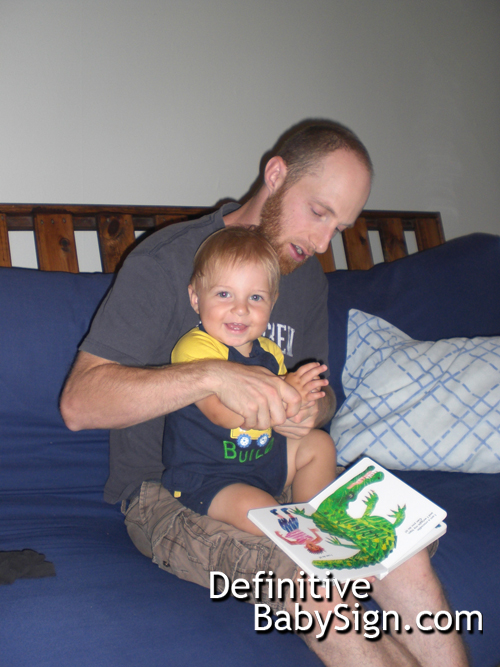
Signing, just for the sake of signing shouldn’t be one of your goals, but if it is, then go right ahead and pop in that DVD and let it do all the work for you. However, if signing is your bridge to connecting with your preverbal baby, then we’re both on the same page together and my program will work wonders for you. The Definitive Baby Sign Program was meant to educate the educators – the parents. While other courses try to skip this step and go right for the children, the Definitive Baby Sign Program aims to turn parents into active participants in the process so they can gain access to their developing children and learn about their little personalities much sooner than non-signing parents and their babies.
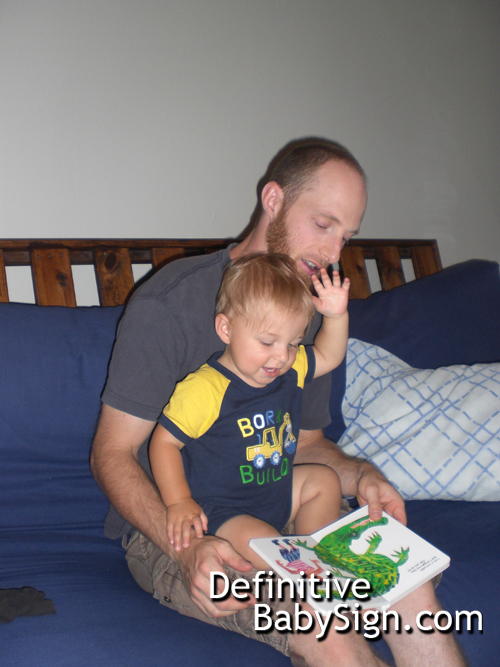
I wont get too aggressive on my condemnation of the DVD programs for kids, as they can make for additional program material, however they shouldn’t be the end of it for you and your baby. When I taught my son to sign, we used several different mediums. We used the Internet to find animal videos and photos, we used books to label various other things and we even used television to expand on our collective experiences. However, we didn’t stop there, we got outdoors to see birds, squirrels, dogs, cats, trees, water, snow and all the good stuff first hand in real life!

While no medium was perfect (not even real life), all of them together put me and my son into today’s word. He learned a little bit about all these things from various angles. In fact, as I type this, I recall tearing pine cones apart to expose their little SEEDS and in the process smell them. Quite fragrant! And if I can make certain about any memory that he and I might share together from an early age, it might just happen to be the smell of fresh pine cones. I highly doubt this could be substituted for any television program.

So while you sign, and while you deliberate on which techniques you might use to sign and from which program, consider what angle you want to teach from. Will you want to just plug-and-play or are you really looking to connect?
Posted in Baby Sign Language Techniques | Leave a comment

Baby Signing Myths ~ Chris

The following are common myths associated with baby sign language:

1. Baby sign language is a new and passing fad for “power moms.”
2. By teaching baby sign, your baby will become a super genius.
3. Baby sign language will use up many hours of your day and require hours of study.
4. Baby sign language will cause speech delays.

Each of these listed above are totally false. Baby sign language has been around for decades and regular everyday mom’s and dad’s have been teaching it to make their lives easier. Baby signing has been shown to help a baby with their language development and has even been shown through research to add up to 12 IQ points, but baby signing will not produce geniuses. Baby signing is just an easy and convenient way to talk with your pre-verbal baby. In fact, baby sign language only takes a primer to set out the rules and from there a few minutes each day to look up additional signs and commit them to memory. The rest of baby sign language involves things you do every day anyway – converse with your baby about your routine and their interests.

Finally, baby sign language has been misconstrued as the cause for speech delays. However, many speech pathologists now recommend it as a way to advance children who already suffer from speech delays. Less than 10% of children will suffer from any significant speech delay and naturally, since there are so many baby signers today, some babies taught to sign will be afflicted with language abnormalities. However, correlation does not equal causation. A baby with a speech delay will in fact benefit greatly from having been taught to sign as it has been shown to improve vocabulary and language.

Posted in General Baby Sign Language | Leave a comment